Cyberworld Guru Inc. | Digital Marketing Services, Islamabad

Blog - Cyberworld Guru Inc.

The Secret Data Your Favorite Apps Are Collecting Without You Knowing

IntroductionIn today’s connected world, mobile apps make our lives easier—but at what cost? Many of your favorite apps are quietly collecting data behind the scenes. From location tracking to behavioral analytics, this hidden data shapes what you see online and how companies target you.1. What Kind of Data Are Apps Collecting?Apps collect more than just your name or email. They track your location, device information, browsing habits, voice commands, and even how long you look at certain content. This information helps developers understand your behavior—but also creates privacy risks. 2. How Is This Data Used?Most companies use this data for personalized advertising and product recommendations. However, in some cases, third-party access or weak security measures can expose sensitive information to hackers or marketers. 3. Why It MattersYour personal data is valuable. Every tap, click, and scroll can tell companies about your lifestyle, preferences, and habits. Being aware of this helps you take control—by adjusting app permissions and using privacy settings wisely.ConclusionDigital convenience shouldn’t come at the cost of your privacy. Stay informed, use trusted apps, and regularly review app permissions to keep your data secure.

Read More »

Why the Websites of the Future Won’t Look Like Websites at All

IntroductionThe way we experience websites is changing fast. Traditional static pages are being replaced by interactive, AI-driven experiences that feel more like digital apps than websites.1. The Shift Toward InteractivityFuture websites will focus less on menus and pages—and more on personalized, conversational design. Imagine landing on a site where an AI assistant guides you instead of static text or buttons. 2. Immersive and Adaptive DesignWeb 4.0 will introduce 3D visuals, voice navigation, and real-time customization. Websites will adapt to user mood, preferences, and location, creating a seamless digital journey. 3. Integration of AI and ARAI chatbots, augmented reality previews, and virtual shopping environments are already redefining user experiences. These innovations will blur the line between websites, apps, and digital spaces. ConclusionThe “webpage” as we know it is evolving. The future belongs to intelligent digital environments that engage, predict, and adapt—creating experiences that feel alive.

Read More »

How Virtual Reality Could Replace Your Daily Commute Sooner Than You Think

IntroductionImagine starting your workday without leaving your home—but still sitting in a fully interactive virtual office. With advances in virtual reality (VR), this future is closer than you think. 1. The Rise of Virtual WorkspacesTech giants are developing VR platforms that simulate real-world offices. You can collaborate, attend meetings, and brainstorm ideas with teammates—all through immersive digital environments. 2. Benefits of a VR CommuteNo traffic, no pollution, and no wasted time. A VR commute improves productivity and reduces stress while keeping remote teams connected and engaged.3. Challenges and the Road AheadWhile VR headsets are becoming more affordable, challenges like motion sickness and network speed still exist. However, as 5G and AI improve, these barriers will fade quickly. ConclusionThe way we “go to work” is changing forever. Virtual reality offers a sustainable, efficient, and interactive alternative to daily travel—one that could redefine our work-life balance.

Read More »

How Quantum Computing Might Secretly Reshape Your Everyday Life

Beyond Supercomputers Quantum computing is often described as too advanced or distant to impact daily life. But the truth is, this technology could soon transform everything from online security to how we shop. At Cyberworld Guru Inc., we believe understanding quantum computing today means staying ahead of tomorrow’s digital shifts. 2. What Is Quantum Computing? Unlike traditional computers that process data in binary (0s and 1s), quantum computers use qubits that can represent multiple states at once. This allows them to solve problems that would take normal computers millions of years. 3. Everyday Applications on the Horizon Online security: Quantum encryption could make data almost unhackable. Healthcare: Quantum simulations could speed up drug discovery. Finance: Banks could predict risks and market trends with unprecedented accuracy. E-commerce: Personalized shopping experiences powered by quantum AI. Logistics: Smarter supply chains with real-time optimization. These advancements will trickle down into daily life in ways we won’t even notice. 4. Challenges Before Mainstream Adoption Cost: Quantum computers are extremely expensive to build. Complexity: Few experts truly understand how to program them. Energy demands: Current quantum systems require highly controlled environments. Accessibility: Widespread commercial use is still years away. 5. Conclusion: Quantum in Daily Life By 2050, quantum computing may be as normal as cloud services today—quietly powering the apps, services, and transactions we rely on daily. At Cyberworld Guru Inc., we track these cutting-edge innovations to help businesses prepare. The quantum era is coming, and those who adapt early will enjoy a massive advantage in the digital economy.

Read More »

What a Digital Clone of Yourself Could Mean for Your Future

The Rise of Digital Clones Imagine having a digital version of yourself that works, learns, and even speaks like you—available online 24/7. Thanks to advances in AI, deep learning, and biometrics, this possibility is closer than ever. Digital clones could transform not just business, but identity itself. At Cyberworld Guru Inc., we explore how this trend will reshape the way we live and work. 2. What Exactly Is a Digital Clone? A digital clone is an AI-driven replica of a person created from: Voice recordings to mimic speech patterns. Behavioral data to simulate decision-making. Appearance modeling using 3D scans or avatars. Knowledge integration to replicate expertise. In short, it’s your digital twin—ready to act on your behalf. 3. Benefits of Digital Clones Business productivity: Your clone can attend meetings or answer customer inquiries. Education: Students could learn from digital versions of expert teachers. Healthcare: Clones could assist in therapy or patient monitoring. Personal legacy: Digital selves could live on beyond one’s lifetime. 4. Concerns and Ethical Questions Privacy: Who owns your digital identity? Misuse: Clones could be hacked or manipulated. Authenticity: How do we distinguish between the real and the clone? Emotional impact: What happens if a clone continues after someone is gone? These issues make digital cloning one of the most debated future technologies. 5. Conclusion: Living With Your Digital Self By 2050, digital clones may be common in business and daily life. They won’t just represent us—they’ll expand what we can achieve. At Cyberworld Guru Inc., we help businesses prepare for an age where digital identity goes beyond profiles and passwords. The future may include not just your online presence—but your digital self.

Read More »

Why your next coworker could be a robot with emotions

Beyond Automation Robots are already part of manufacturing and logistics, but the next frontier is the workplace. Thanks to advances in Artificial Intelligence (AI) and emotional recognition technology, future robots won’t just perform tasks—they’ll respond emotionally. Your next coworker may laugh at your jokes, encourage you during a tough day, and collaborate just like a human colleague. 2. The Rise of Emotional AI Robots with emotions aren’t about feelings—they’re about simulating empathy. Using AI, sensors, and facial recognition, these robots can: Detect human emotions through tone, gestures, and expressions. Respond with empathy to boost teamwork. Adapt behavior based on workplace culture. Learn from interactions to improve collaboration. 3. Benefits of Emotional Robots at Work Improved teamwork: Robots can reduce tension by responding empathetically. Efficiency: Machines handle repetitive tasks while humans focus on creativity. Accessibility: Robots can support employees with disabilities. 24/7 availability: Work continues without fatigue or burnout. 4. Challenges and Ethical Concerns Trust issues: Will humans accept robots as “coworkers”? Job displacement: Some roles may be replaced. Ethical dilemmas: Should robots “fake” emotions? Dependency risks: Overreliance on machines could reduce human connections. 5. Conclusion: The Human-Robot Workplace By 2050, emotional robots could become as normal as laptops in the office. Far from replacing humans, they’ll enhance collaboration in ways we’re only beginning to imagine. At Cyberworld Guru Inc., we guide businesses through these technological shifts, ensuring they adopt robotics and AI responsibly—balancing efficiency with empathy in the workplace of the future.

Read More »

How brain chip technology could change the way we dream

From Science Fiction to Reality Brain chips sound like something out of a sci-fi movie, but technology is moving fast. Scientists are already experimenting with neural interfaces that connect the brain to computers. One of the most fascinating (and controversial) possibilities? Influencing and recording our dreams. At Cyberworld Guru Inc., we explore these future technologies to help businesses prepare for what’s coming next. 2. How Brain Chips Work Brain-computer interfaces (BCIs) use sensors to detect brain signals and translate them into digital commands. In the future, these chips could: Stimulate specific areas of the brain to influence dreams. Record dream activity for playback and analysis. Enable “lucid dreaming” on demand. This could turn dreams into a new form of entertainment or therapy. 3. Potential Benefits Mental health treatment: Dreams could be shaped to reduce anxiety or trauma. Creativity: Artists and innovators could use dreams for inspiration. Education: Learning in dreams could accelerate skill acquisition. Entertainment: Imagine “dream experiences” as a new media industry. 4. The Concerns and Risks Privacy: Do we want companies accessing our dreams? Addiction: Escaping into dream worlds instead of reality. Ethical dilemmas: Who controls the content of your dreams? Health risks: Long-term impacts of brain chips are still unknown. 5. Conclusion: Dreaming in the Digital Age By 2050, dreams may not be entirely private or random anymore—they may be programmable. At Cyberworld Guru Inc., we track these advancements because they don’t just impact individuals; they reshape industries. Businesses that stay ahead of brain-chip technology will be ready for the most radical shifts in human experience.

Read More »

How Virtual Reality Will Change the Way We Shop Online Forever

The Future of Online Shopping E-commerce has already transformed retail, but the next revolution is on the horizon: Virtual Reality (VR). Imagine walking through a digital store, picking up products, and trying them out—all from your living room. At Cyberworld Guru Inc., we believe VR is set to redefine how businesses and customers interact in the digital marketplace. 2. Why VR Shopping is a Game-Changer Unlike traditional online shopping, VR offers: Immersive product exploration (try before you buy). 3D environments that simulate real stores. Interactive experiences that engage customers. Personalized shopping journeys tailored to preferences. This level of immersion builds confidence and reduces hesitation in purchasing decisions. 3. The Benefits for Businesses and Customers For Customers: VR shopping reduces uncertainty, especially with clothes, furniture, or gadgets. For Businesses: It lowers returns, increases engagement, and provides valuable insights into customer behavior. For Brands: It creates memorable, shareable experiences that boost loyalty. 4. The Tech Behind VR Shopping VR commerce is made possible by: AI-powered recommendation engines. High-speed 5G networks for real-time rendering. Cloud computing to handle large-scale virtual environments. Augmented Reality (AR) integrations for mobile shopping. Together, these technologies create smooth, life-like shopping experiences. 5. Challenges on the Path to Adoption VR shopping faces hurdles, including: High equipment costs for consumers. Need for fast internet and powerful devices. Skepticism among traditional shoppers. Development costs for brands entering VR spaces. But as technology becomes more affordable, these challenges will fade. 6. Conclusion: Shopping in the Virtual Future By 2050, VR shopping could become as normal as browsing an online store today. Businesses that embrace it early will have a massive competitive edge. At Cyberworld Guru Inc., we help brands prepare for this future by integrating immersive digital experiences into their marketing strategies. From virtual showrooms to interactive product demos, we create experiences that turn browsing into buying.

Read More »

Why Your Next Customer Service Agent Might Be an AI with a Personality

The Shift in Customer Experience Customer service has always been at the heart of business success. But in today’s fast-paced digital world, customers expect instant responses, 24/7 availability, and personalized interactions. This is where AI-driven virtual agents are stepping in—not just to provide answers, but to hold conversations that feel human. At Cyberworld Guru Inc., we see AI as more than automation—it’s the future of customer engagement. 2. What Makes AI-Powered Agents Different? Unlike traditional chatbots that rely on scripted answers, next-generation AI agents use: Natural Language Processing (NLP) to understand human language. Machine Learning (ML) to learn from past interactions. Sentiment Analysis to detect emotions in customer messages. Custom Personalities that align with a brand’s tone of voice. These agents don’t just respond—they connect. 3. The Benefits of AI Customer Service AI-powered support offers businesses: 24/7 availability without staffing challenges. Instant resolution for common queries. Consistency in tone across all interactions. Scalable support during peak hours. Personalized recommendations based on customer history. This makes customer service faster, smarter, and more cost-effective. 4. The Human Touch in AI One surprising trend is the rise of AI with personalities—agents that can be empathetic, humorous, or professional depending on brand strategy. Instead of robotic replies, customers get engaging conversations that improve trust and satisfaction. 5. Challenges to Consider Of course, AI isn’t without limitations: Complex queries may still require human intervention. Data privacy must be carefully protected. Over-automation can feel impersonal if not balanced correctly. The solution lies in blending AI with human oversight for the best experience. 6. Conclusion: The Future of Customer Engagement By 2030, AI agents are projected to handle the majority of first-line customer interactions. Businesses that embrace this technology today will lead tomorrow in customer experience. At Cyberworld Guru Inc., we help companies integrate AI-powered customer service tools that don’t just answer questions—they create meaningful connections. Whether you want to cut response times, scale support, or redefine customer experience, we’ll help you do it with AI that speaks your brand’s language.

Read More »

How AI Will Completely Reinvent Your Social Media Feed by Next Year

Social Media’s Next Big Shift Your social media feed already looks different from five years ago—but the changes coming in the next 12 months will be even bigger. Artificial Intelligence is set to completely reinvent how you consume content online, and brands need to prepare now. 2. Personalized Feeds Like Never Before AI algorithms will deliver hyper-personalized feeds that predict what users want before they even search. Imagine seeing posts tailored to your mood, location, or even shopping habits in real time. 3. The Rise of AI-Generated Influencers Virtual influencers, powered by AI, are already gaining massive followings. These digital personalities don’t sleep, don’t make mistakes, and can engage with audiences 24/7. By next year, expect to see more brands partnering with AI-driven influencers to reach younger audiences. 4. Predictive Engagement: Content Before You Ask AI won’t just react to your clicks—it will anticipate your interests. That means businesses must create content that’s ready to surface when the algorithm predicts a user’s need. 5. Implications for Brands and Ads This shift means: Traditional ad targeting will give way to AI-driven recommendations. Brands will need to focus on authenticity and trust as feeds become saturated with AI content. Engagement strategies must prioritize value and personalization. 6. Conclusion: Adapting Your Strategy for an AI-Driven Feed AI will reshape not just what users see but also how brands connect with them. Companies that adapt quickly will thrive in this new landscape. At Cyberworld Guru Inc., we design AI-ready social media strategies that help businesses stay visible, relevant, and engaging. If you want your brand to stand out in tomorrow’s feeds, contact us today.

Read More »

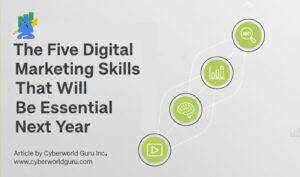
The Five Digital Marketing Skills That Will Be Essential Next Year

The Future Belongs to Adaptable Marketers Digital marketing evolves faster than any other industry. What worked yesterday may not work tomorrow. To stay competitive, businesses and marketers must master the skills that will shape the next year of online growth. At Cyberworld Guru Inc., we keep a close eye on these shifts to prepare our clients for success. 2. Skill #1: SEO and Content Strategy Search engines remain the backbone of online discovery. But next year, SEO will go beyond keywords. Businesses must embrace search intent optimization, voice search, and AI-driven content strategies to ensure visibility. 3. Skill #2: AI and Automation Tools From chatbots to automated email campaigns, AI is no longer optional. Marketers who can harness AI tools to analyze data, predict customer behavior, and personalize experiences will have a huge advantage. 4. Skill #3: Data Privacy and Analytics Consumers are more aware than ever about data collection. Understanding regulations like GDPR, while still leveraging analytics, will be a crucial skill. Marketers must balance personalization with privacy to build trust. 5. Skill #4: Social Media Innovation Algorithms are constantly changing. Next year, social media success will rely on short-form video, AI-driven feeds, and community building. Marketers must know how to engage audiences in these evolving ecosystems. 6. Skill #5: Immersive Technologies (AR/VR) Augmented reality (AR) filters and virtual reality (VR) shopping experiences are no longer futuristic—they’re here. Marketers who embrace immersive campaigns will stand out in crowded markets. 7. Conclusion: Equip Your Business with the Right Skills The next year will reward those who adapt early. From SEO to immersive technologies, these skills are the new essentials of digital marketing.

Read More »

The Surprising Secret to a Viral Social Media Campaign

Why Virality Matters Every business dreams of going viral on social media. A single post can skyrocket brand awareness, boost sales, and create loyal fans overnight. But is virality about luck or big ad budgets? The truth may surprise you. 2. Myth: Virality Requires Big Budgets Many assume only large companies with big ad spends can go viral. In reality, some of the most successful viral campaigns started as low-cost, authentic posts created by small businesses. 3. The Real Secret: Emotional Connection What truly drives virality is emotional triggers. Content spreads when people feel something powerful enough to share. The most effective triggers include: Humor – relatable jokes people can’t resist sharing. Inspiration – uplifting stories that motivate. Surprise – unexpected or shocking twists. Relatability – content that reflects everyday struggles. 4. Case Studies of Viral Campaigns A local bakery shared heartfelt TikTok videos about its community—and gained millions of views. A budget airline went viral on Twitter with witty, relatable replies. These examples prove one thing: authenticity beats flashy ads. 5. The Role of AI in Predicting Virality By 2026, AI tools will predict trends and analyze audience behavior to forecast which posts are most likely to go viral. Brands that adopt these tools will gain a competitive edge in social media marketing. 6. Conclusion: Build Campaigns That Connect The secret to viral campaigns isn’t spending more—it’s connecting more. Authentic, emotionally-driven content wins hearts and spreads fast. At Cyberworld Guru Inc., we specialize in creating social media strategies that resonate, engage, and grow. Whether you’re a small business or a global brand, our campaigns are built to connect and convert.

Read More »

Can AI Really Write Better Content Than Humans?

The Rise of AI Writers Artificial Intelligence is transforming the way businesses create content. From blog posts and product descriptions to ad copy, AI tools promise speed and scale like never before. But here’s the big question: can AI really write better content than humans? 2. The Strengths of AI Content AI writing tools offer undeniable advantages: Speed: They generate thousands of words in minutes. SEO optimization: AI quickly identifies trending keywords. Consistency: Machines don’t get tired, ensuring uniform tone. For businesses producing bulk content, these strengths can save time and money. 3. The Limitations of AI Writing However, AI isn’t perfect. Its main weaknesses include: Lack of emotional intelligence – struggles with humor and cultural nuance. Limited creativity – repurposes patterns but rarely innovates. Authenticity issues – robotic content may reduce audience trust. 4. When AI Outperforms Humans AI shines in areas where data and structure matter most: Large-scale product descriptions for e-commerce sites. Analytical reports that focus on facts, not storytelling. SEO-driven articles requiring keyword density and formatting. 5. The Future: Human + AI Collaboration The most powerful approach isn’t “AI vs. humans.” It’s AI plus humans working together. AI handles research and optimization, while human writers bring creativity, empathy, and storytelling that resonate emotionally with readers. 6. Conclusion: Why Humans Still Matter in Marketing AI is a powerful tool, but it’s not a replacement for human creativity. The future of content lies in collaboration between AI efficiency and human insight. At Cyberworld Guru Inc., we combine AI-driven data with human creativity to produce content that ranks well and connects deeply with audiences. Let us help your business create smarter, more effective digital content.

Read More »

What Will the Internet Look Like in 2050?

Imagining the Internet in 2050 The internet has transformed our world in just a few decades—from dial-up connections to high-speed 5G. But what comes next? Experts predict that by 2050, the internet will look nothing like it does today. With breakthroughs in AI, quantum computing, virtual reality, and brain-chip technology, our online experiences will become faster, smarter, and more immersive. At Cyberworld Guru Inc., we help businesses prepare for this rapidly evolving digital landscape. 2. From Web 2.0 to Web 5.0: The Next Evolution Today’s internet revolves around social media and mobile apps. But by 2050, we’ll likely enter Web 5.0—a world of fully immersive, 3D digital environments where humans and machines interact seamlessly. Instead of clicking on websites, you may “walk into” virtual offices, stores, or classrooms powered by AI. 3. The Role of Quantum Computing Current computers have limits, but quantum computing will break barriers by processing massive amounts of data instantly. Imagine search engines predicting your needs before you type, or businesses creating real-time, hyper-personalized experiences for every visitor. 4. Brain Chips and Digital Clones Technology will go beyond devices. Brain-computer interfaces could allow people to browse, shop, or even design products with their thoughts. Meanwhile, digital clones—AI-powered versions of ourselves—may one day interact online on our behalf. 5. What Businesses Should Prepare For The internet of 2050 won’t just be about websites. Businesses must prepare for: Immersive digital storefronts instead of traditional sites. SEO strategies that optimize for emotions and behaviors, not just keywords. AI-driven personalization, where every user has a unique journey. 6. Conclusion: Preparing Your Business for the Future The internet in 2050 will be intelligent, immersive, and deeply personal. The businesses that thrive will be the ones that adapt early. At Cyberworld Guru Inc., we design strategies to help companies stay ahead—whether through future-ready web development, SEO optimization, or social media marketing. Based in Islamabad, we proudly serve clients across Pakistan and worldwide.

Read More »

From Clicks to Conversions: The Art of a High-Converting Landing Page

1. Introduction: Why Landing Pages Matter More Than Ever In the digital marketing world, getting traffic is only half the battle—the real success lies in turning those clicks into paying customers. That’s where high-converting landing pages come in. A well-crafted landing page doesn’t just grab attention; it guides visitors toward taking meaningful action, whether that’s making a purchase, signing up for a newsletter, or filling out a contact form. At Cyberworld Guru Inc., we specialize in building landing pages that not only look good but also deliver results.   2. What Makes a Landing Page “High-Converting”? A landing page is designed with one clear objective: conversion. Unlike a homepage, which offers multiple navigation options, a landing page focuses visitors on a single call-to-action (CTA). Key elements that make a landing page high-converting include: A clear, compelling headline. Visually appealing design with minimal distractions. Concise, benefit-driven content. Strong and visible CTAs. Trust signals like testimonials, reviews, or security badges. When done right, a landing page becomes a powerful sales tool.   3. The Psychology Behind Effective Landing Pages High-converting landing pages are built on understanding customer psychology. Visitors make decisions within seconds, so your page must build trust instantly. Proven psychological triggers include: Urgency and scarcity: Limited-time offers push visitors to act quickly. Social proof: Reviews and testimonials reassure customers. Clarity over creativity: Simple, direct language outperforms complex jargon. By aligning with customer expectations, you guide visitors smoothly toward conversion.   4. Essential Design Elements of a Winning Landing Page Great design goes beyond looks—it supports conversion. Some must-have design practices include: Mobile optimization: With most users on smartphones, mobile-friendly design is non-negotiable. Fast loading speed: A delay of even 2 seconds can drastically reduce conversions. Visual hierarchy: Use bold headings, contrasting CTA buttons, and structured layouts to direct user focus. Engaging visuals: High-quality images or explainer videos increase trust and engagement. These design choices ensure that visitors stay longer and are more likely to act.   5. Testing and Optimizing for Higher Conversions The secret to a successful landing page is continuous optimization. Businesses should regularly test elements like: CTA button colors and placements. Headline variations. Length of content (short vs. detailed). Form fields (fewer fields often mean more conversions). Through A/B testing and analytics, you can discover what resonates most with your audience and refine your landing page for maximum impact.   6. Conclusion: Build Landing Pages That Convert with Cyberworld Guru Inc. Every click on your ad, email, or social media post is an opportunity. But without a high-converting landing page, those opportunities are wasted. By combining psychology, design, and data-driven optimization, businesses can transform casual visitors into loyal customers.   At Cyberworld Guru Inc., based in Islamabad and serving clients across Pakistan and worldwide, we create conversion-focused landing pages that fuel business growth. Whether you need a product launch page, a service sign-up page, or an e-commerce landing page, our expertise ensures every click counts.

Read More »

The Role of Data Analytics in Building Smarter Marketing Campaigns

1. Introduction: Why Data Analytics Is the Key to Modern Marketing In today’s competitive digital landscape, businesses cannot afford to rely on guesswork. Data analytics has become the backbone of successful marketing, helping brands make informed decisions, improve customer engagement, and maximize ROI. At Cyberworld Guru Inc., we empower businesses in Pakistan and around the world to leverage data-driven marketing strategies that deliver measurable growth. 2. What Is Data Analytics in Marketing? Data analytics in marketing refers to collecting and analyzing information about customer behavior, campaign performance, and market trends. Instead of assumptions, businesses use real-time data to: Track customer journeys across websites and social platforms. Identify high-performing ads, content, and keywords. Understand customer intent and purchase behavior. This data-driven approach ensures campaigns are precise, relevant, and impactful. 3. Personalization: Delivering What Customers Really Want One of the greatest benefits of data analytics is personalized marketing. Customers today expect brands to understand their needs. With data insights, businesses can: Segment audiences by interests, demographics, and behavior. Send customized email campaigns. Create targeted social media ads and product recommendations. Personalized campaigns not only build stronger relationships but also increase conversions and customer loyalty. 4. Optimizing Campaign Performance with Data Data analytics allows marketers to monitor every aspect of their campaigns. By reviewing metrics such as CTR, engagement rates, and conversions, businesses can: Adjust campaigns in real-time. Allocate budgets more effectively. Identify and eliminate low-performing strategies. This leads to smarter decision-making and a higher return on investment. 5. Predictive Analytics: Preparing for the Future Beyond analyzing past performance, predictive analytics uses machine learning and AI to forecast future trends. For small and large businesses alike, this means: Anticipating customer behavior. Launching campaigns at the right time. Staying ahead of competitors in crowded markets. Predictive data empowers businesses to plan long-term strategies that are both innovative and customer-focused. 6. Conclusion: Turning Data into Action with Cyberworld Guru Inc. Data analytics is no longer optional—it’s essential. Businesses that rely on data-driven strategies are more likely to succeed in building smarter marketing campaigns, increasing conversions, and strengthening brand loyalty. At Cyberworld Guru Inc., based in Islamabad and serving clients worldwide, we specialize in combining website development, SEO optimization, and social media marketing with powerful data insights. If you want your campaigns to be smarter, measurable, and result-driven, we are here to help you succeed.

Read More »
Call us